Foreign news
Russia-Africa Summit More About Optics Than Results
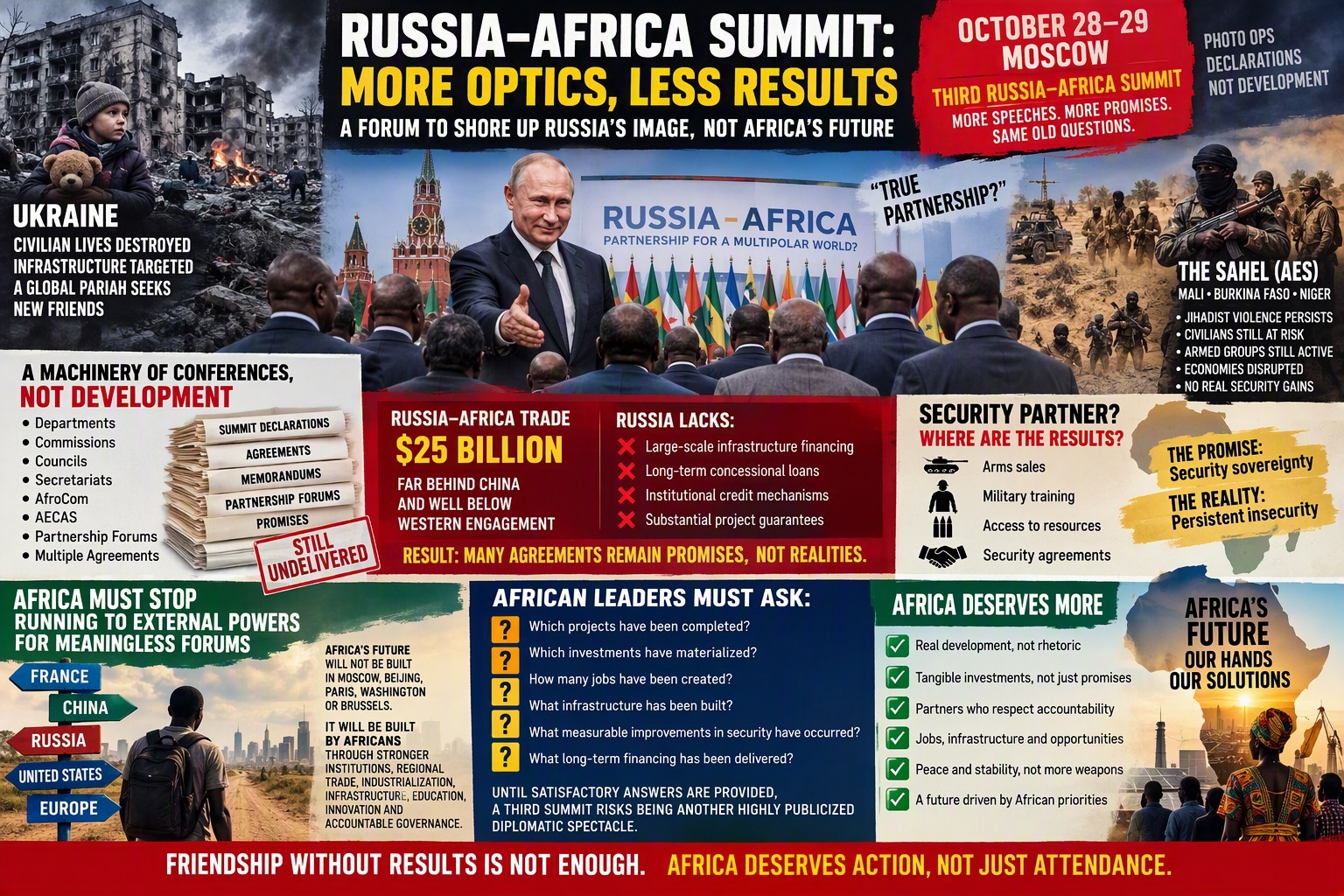
The plan by Russia to host a third Russia-Africa Summit in October deserves to be treated with deep caution. While Moscow is packaging the meeting as a demonstration of genuine partnership and commitment to Africa's growth, the event looks more like an attempt to boost its global image at a time its actions in Ukraine are under intense international scrutiny, and to divert attention from its poor economic delivery and controversial security footprint on the continent.
By Ipole AMAJAMA
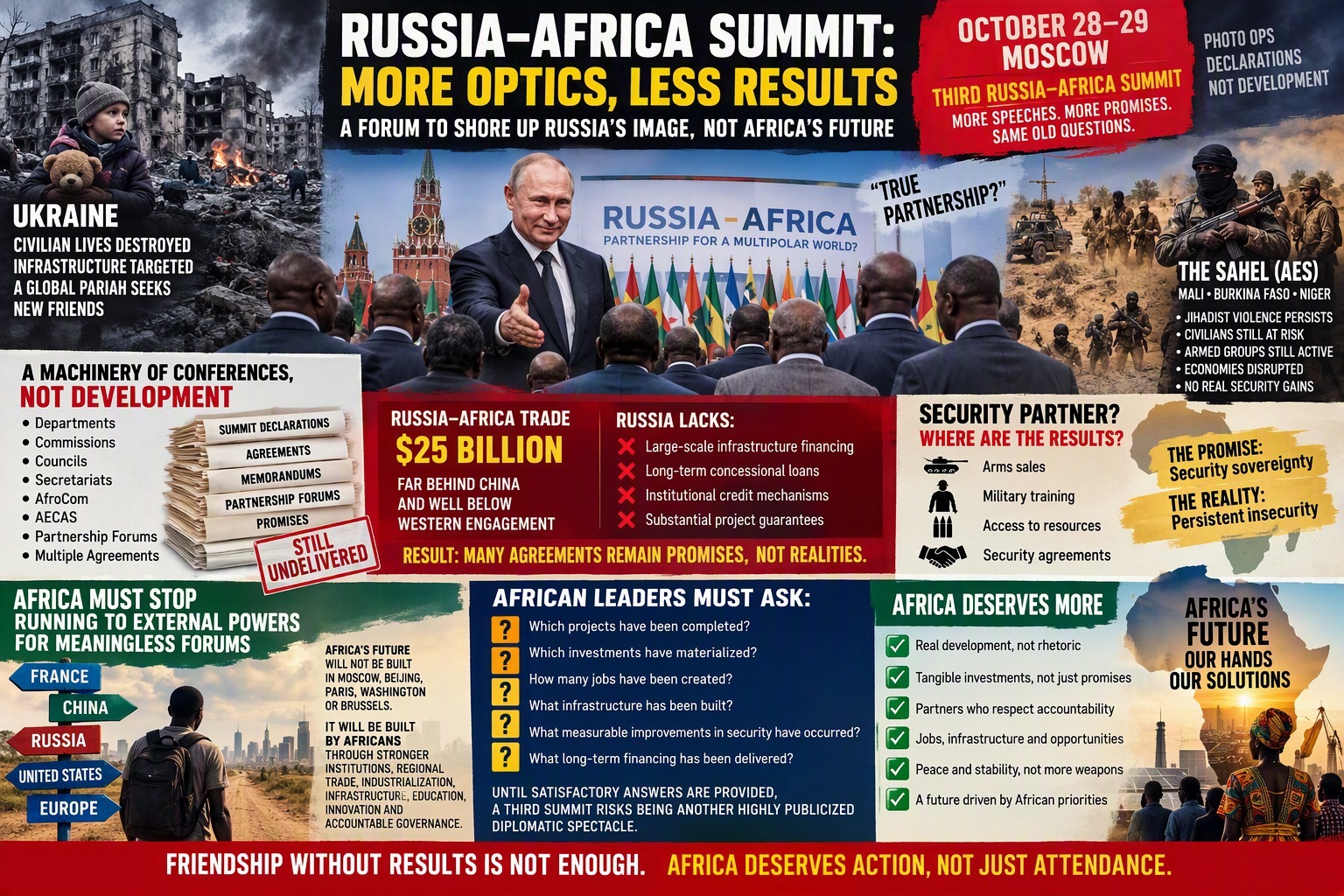
The plan by Russia to host a third Russia-Africa Summit in October deserves to be treated with deep caution. While Moscow is packaging the meeting as a demonstration of genuine partnership and commitment to Africa's growth, the event looks more like an attempt to boost its global image at a time its actions in Ukraine are under intense international scrutiny, and to divert attention from its poor economic delivery and controversial security footprint on the continent.
The timing is critical. Since its invasion of Ukraine in 2022, Russia has been cut off from Western markets and institutions. With sanctions, diplomatic pressure and condemnation over military operations that have destroyed civilian infrastructure, Moscow has been searching for alternative platforms to portray itself as still globally relevant and supported. The Russia-Africa Summit provides that stage.
Instead of serving as a platform for concrete development outcomes, the summit is likely to end up as a geopolitical showpiece where photo opportunities, speeches and communiques replace tangible progress. African leaders should be asking a straightforward question: after two summits, hundreds of agreements, and a host of commissions, councils, secretariats and partnership forums, what real transformation has been achieved?
The answer is very little, a bureaucracy of conferences, not development. Moscow boasts an elaborate array of institutions devoted to Africa: the Department of Sub-Saharan Africa, the Russia-Africa Partnership Forum Secretariat, several councils, AfroCom, AECAS, Joint Intergovernmental Commissions and trade sections in its missions. In spite of this huge bureaucracy, Russia's economic presence in Africa remains negligible.
Its trade with Africa stands at about $25 billion, still far behind China and well below Western engagement. More significantly, Russia does not have the financial instruments that make real development partnership possible. Unlike Chinese policy banks or Western development finance institutions, Moscow cannot offer large-scale infrastructure funding, long-term concessional loans or substantial project guarantees.
Consequently, most of the agreements signed at the previous summits have remained on paper. Africa does not need another summit declaration. What it needs are roads, power plants, ports, factories, digital infrastructure and jobs. Russia has shown little capacity to deliver these on a large scale.
The most obvious contradiction is Moscow's claim to be a dependable security partner. Russia's engagement in Africa has focused heavily on military cooperation, arms sales, security training and resource-for-access deals. Yet the countries most closely linked to Russian security support remain highly unstable.
The Alliance of Sahel States, AES, made up of Mali, Burkina Faso and Niger, was promoted by supporters of Russian involvement as an alternative security framework free from Western control. Yet jihadist attacks continue unabated across the region.
This raises a basic question: what security guarantees has Africa actually got? If Russian security partnerships are meant to stabilise fragile states, where is the evidence? Large parts of the Sahel are still under the control of Islamist insurgents. Civilian casualties persist. Armed groups still move freely. Economic activities remain paralysed. Millions of people remain at risk.
It must be clearly stated that what was promised was security sovereignty, but what has been delivered is often continued insecurity. If Moscow cannot show clear security gains in the countries where its influence is strongest, African governments should be wary of its narratives on stability and partnership.
Russia's claim to be promoting peace, sovereignty and development abroad is further undermined by its conduct in Ukraine. A country that preaches partnership while waging a destructive war has a serious credibility deficit.
The summit will likely be filled with rhetoric about multipolarity, anti-colonial solidarity and respect for sovereignty. Yet many observers will see a contradiction between those pronouncements and Russia's military aggression in Ukraine. African states, many of which fought long battles against domination and external interference, should be particularly sensitive to such inconsistencies between words and actions.
The main issue is not that Russia seeks influence, every major power does. The issue is whether African governments are being asked to ignore troubling realities in return for symbolic diplomatic engagement. The summit therefore risks becoming a reputation-laundering exercise, enabling Moscow to parade the attendance of African leaders as proof that it remains a respected global player despite mounting international condemnation.
For decades, African governments have been told that their development depends on alliances with outside powers. First Europe. Then France. Then the United States. Then China. And now, increasingly, Russia. The pattern is strikingly similar.
African leaders attend summits, sign declarations, announce strategic partnerships and celebrate new eras of cooperation. Yet structural problems persist across the continent. The challenge is not engagement with foreign nations. International cooperation is still vital. The challenge is dependence on external powers as the main engine of development.
Africa's economic independence will not come from Moscow, Beijing, Paris, Washington or Brussels. It will come from stronger domestic institutions, regional trade, industrialisation, infrastructure investment, educational advancement, technological innovation and accountable leadership.
After two Russia-Africa summits, African leaders should demand proof: Which projects have been completed? Which investments have materialised? How many jobs have been created? What infrastructure has been built? What concrete security improvements have been recorded? What long-term financing has been provided?
Until convincing answers are given, a third summit will risk becoming what the first two largely were: a highly publicised diplomatic spectacle where declarations far outweighed results.
Africa deserves more than geopolitical courtship. It deserves partners who deliver measurable development, uphold accountability and provide concrete benefits, not symbolism.
The question before African leaders in Moscow, therefore, is not whether Russia is a friend. It is whether friendship without results is enough. Based on the evidence so far, the answer should be no.
Amajama, a social and policy analyst, writes from Abuja and can be reached via amajamaip@gmail.com

0 Comments
Be the first to comment on this story.